
the truth in a rigged society can only come from an “outsider” perspective.
In an age of screens and artificial intelligence, the human presence instantly infers risk. I want an audience in the room—not as consumers, but as witnesses.
Born in Queens, New York, Dennis Leroy Kangalee entered The Juilliard School as an actor in 1994, where he later became the first artist to induct a Black Theater History Seminar in Lincoln Center (1996). His departure from the conservatory became the beginning of a different education: in radical theater, Black dramatic literature, independent performance and the relationship between art and social conscience. By the late 1990s, Kangalee had turned from acting toward directing, staging plays by writers including Amiri Baraka and Jean Genet while developing an increasingly personal conception of theater rooted in the actor, the outsider and the moral necessity of art.
While many of his contemporaries went Hollywood, Kangalee went neighborhood—building his practice in downtown experimental theater and Black theater in Harlem. Turning formally to directing in 1997, and conceding to his proclivity as a theatrical auteur, he developed an actor-centered approach to directing through productions at the Ohio Theatre, HERE and the National Black Theatre. His 1999 revival of James Baldwin’s Blues for Mister Charlie, featuring longtime collaborator Ward Nixon, brought together concerns that would remain central to his work: rigorous acting, Black dramatic literature, political consciousness and the theater as a place of confrontation.
In 2001, Kangalee made the independent feature As an Act of Protest, writing, directing and performing in a film about racism, police violence and the psychological torment of an artist caught between creation and revolution. Made under his former name, Dennis Leroy Moore, the film marked a decisive turn: after years of directing other writers, Kangalee had begun creating a dramatic language of his own. Its collision of revolutionary rage, isolation and artistic conscience would become a foundation for much of the work that followed.
Over the next two decades, Kangalee moved between writing (poetry, screenplays - including Octavia: Elegy for a Vampire, which was later sold, and re-worked adaptations like his screenplay of Goin’ a Buffalo — written with the author of the original play, Ed Bullins) and increasingly solitary forms of performance.
In Gentrified Minds (2011), he returned to the stage through the persona of the Nomad Junkie, combining monologue, music, political invective and poetry. A decade later, after years away from acting, Samuel Beckett’s Krapp’s Last Tape brought him back to the stage in a radically different form: one actor, a voice, a body, memory and silence. The experience renewed his fascination with the solitary performer and began the movement toward the stripped-down work he makes today.
Kangalee’s work has also extended into criticism and cultural writing. From 2022–2025, he wrote film criticism for the Luminal Theater’s Wavelengths, continuing an engagement with the artist-as-critic exemplified for him by writers including Amiri Baraka, John Berger, Antonin Artaud and Lester Bangs.
Kangalee’s writing has also appeared beyond the theater. His work on art, trauma and consciousness was published in the Journal of Humanistic Psychology in 2021, and in 2022 he contributed an essay on William S. Burroughs to Fever Spores, edited by Brian Alessandro and Tom Cardamone. That same year he founded the Kangalee Arts Ensemble, a nonprofit repertory company through which he continued his exploration of actor-driven, politically engaged theater. In 2024, The Life & Death of Art, his first original play for the stage, marked another decisive turn: the director, filmmaker and performer had now become a playwright.
The movement toward the solitary performer deepened in 2025, when Kangalee was commissioned by the Henry Miller Memorial Library to adapt Miller’s The Smile at the Foot of the Ladder for the stage. It was the first time a North American artist had ever adapted the work of Miller to the stage, with the support of his Estate. The resulting work, SMILE: A Clown’s Ascension, brought him back to a story he had first encountered decades earlier and transformed Miller’s Auguste into a vehicle for his own preoccupations with the artist, isolation and transcendence. Performed by Kangalee himself, SMILE brought writing, adaptation, and acting into increasingly intimate proximity—and pointed toward a theater requiring less apparatus and greater exposure.
In 2026, Kangalee became a recipient of a Venturous Theater Fund grant and returned to ensemble drama with My Dying City Vol. II (The Social Justice Suicide Hour) and The Harm, two plays that brought his long-standing concerns with political conscience, language, grief and moral responsibility into increasingly intimate theatrical spaces. But the trajectory that began with Krapp and deepened through SMILE continued to pull him toward solitude.
His current work returns to the monologue—or, as he prefers it, the MONO: performance essays, self-portraits and acts of direct address in which the distance between writer, performer and audience becomes increasingly difficult to locate.
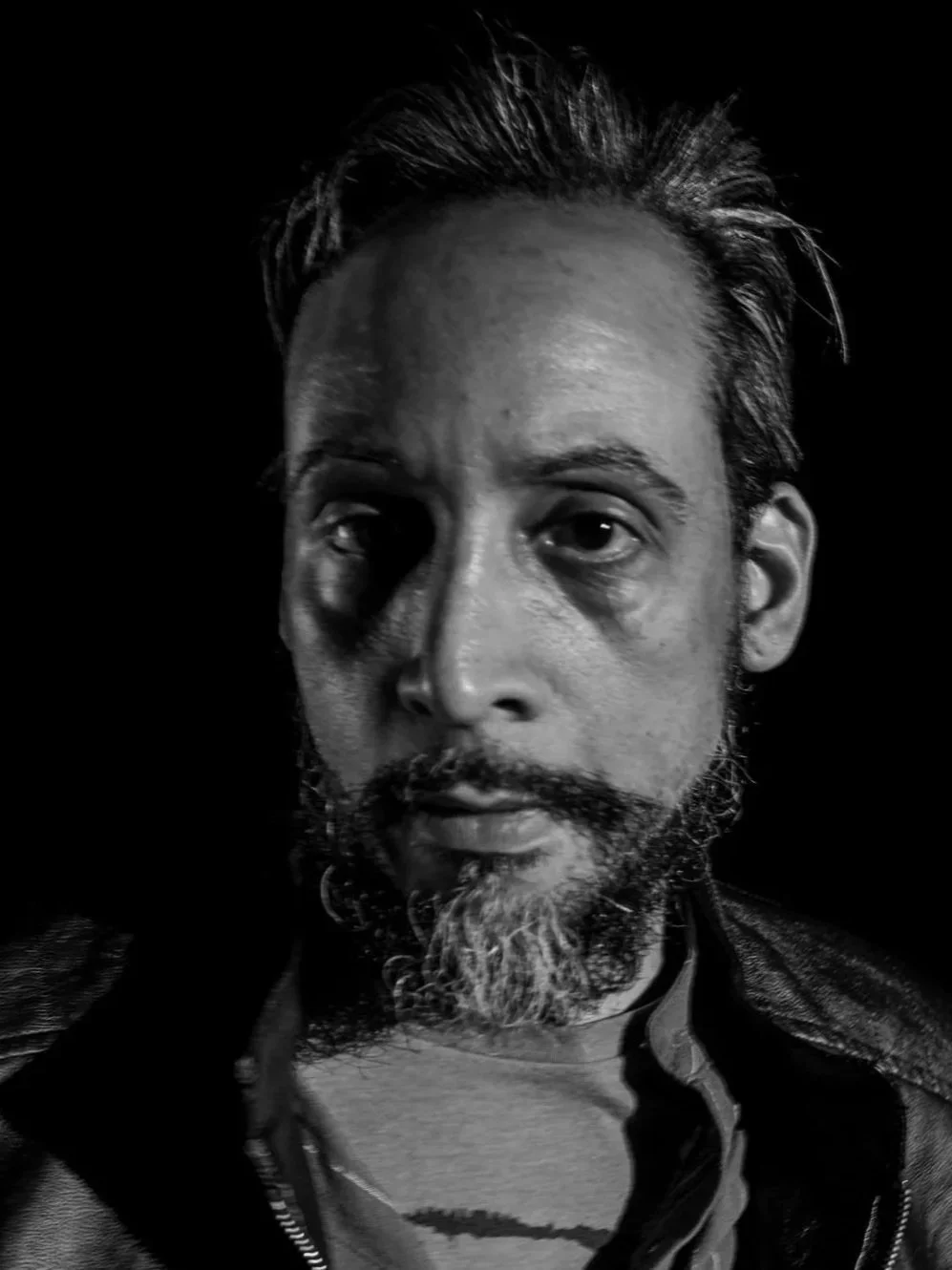
Kangalee at Studio 111 in Williamsburg, Brooklyn. Photo by filmmaker Kofi Ofosu-Yeboah.