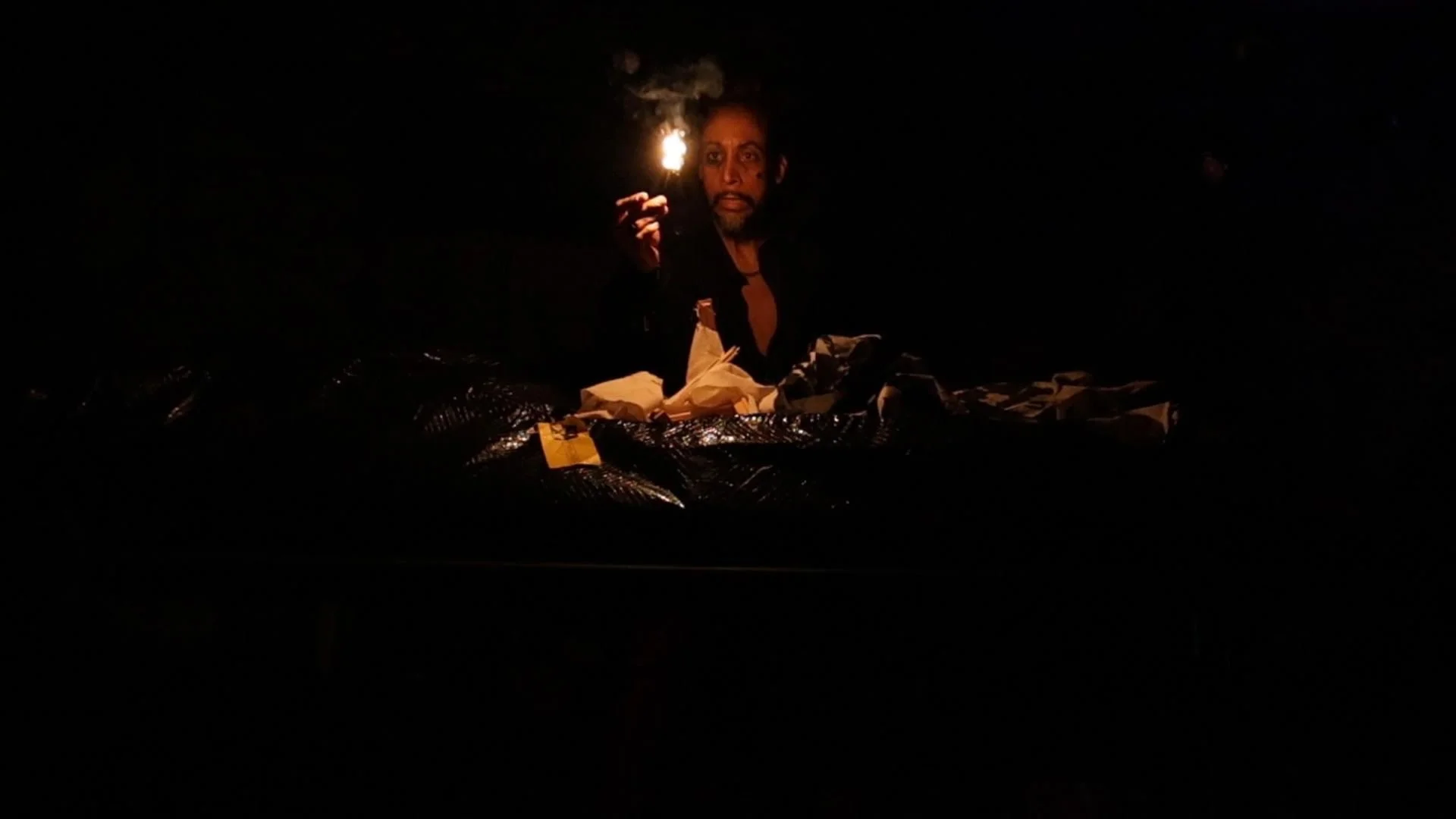
“Since the 1990’s I have sought to create a body of work myself - and with a group - that could develop a personal style and imbue ideas about racism and oppression - just like an individual author… And through it all I have sought to impact those whom we often do plays about: the outsiders, the rebels, the romantics, the justice seekers, the dispossessed, the unemployed, the lonely, the broken, the empathic. Neighborhood was always the goal. Not Hollywood…To share our humanity creatively and have it reflected back to us by audiences is a powerful thing. Whether it is an ensemble or monologue.”
- Dennis Leroy Kangalee
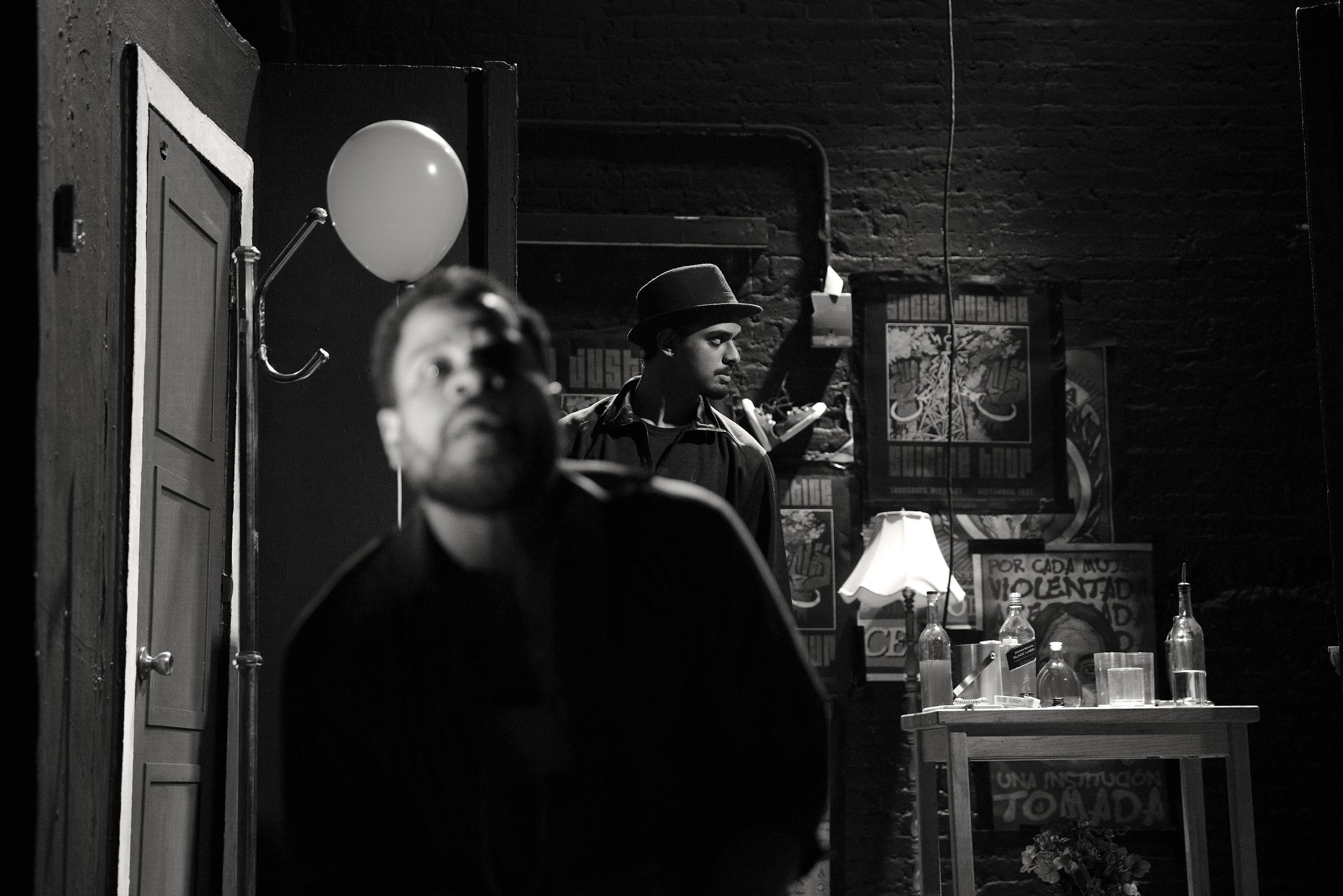
The horrifying ending of Kangalee’s 2026 masterpiece “My Dying City Vol.II (The Social Justice Suicide Hour)” a play that explored aspects of grief, indecision, confusion, the inner conflicts of The Left…and heartbreak of revolutionary ideals. Featured here is Che Ayende and Brandon Geer, background. Photo by Tessa Blythe Young.
THEATRICAL HISTORY
The pandemic of 2020 inspired a reassessment of what live performance and theater was.
While Dennis Leroy Kangalee’s (DLK) critical voice developed a shape and rancor of its own in the years he focused on his non-fiction writings, his entire approach to acting changed, deepened and brought a state of grace he had longed for when he returned to the stage after a decade. With the Kangalee Arts Ensemble’s November 2022 revival of KRAPP'S LAST TAPE by Samuel Beckett, everything changed. An intriguing extension of his ongoing ceaseless investigations into solo performance, monologues, the absurd and the clown, it had been a kind of chimera for DLK’s since 1995, when he first performed it at Juilliard. Years later, it was in the midst of the Covid pandemic that he understood how to play it. This reignited his interest in theater and a year long workshop began, first in his Jackson Heights living room and then eventually onto the public stage at Studio 111 in Williamsburg, Brooklyn.
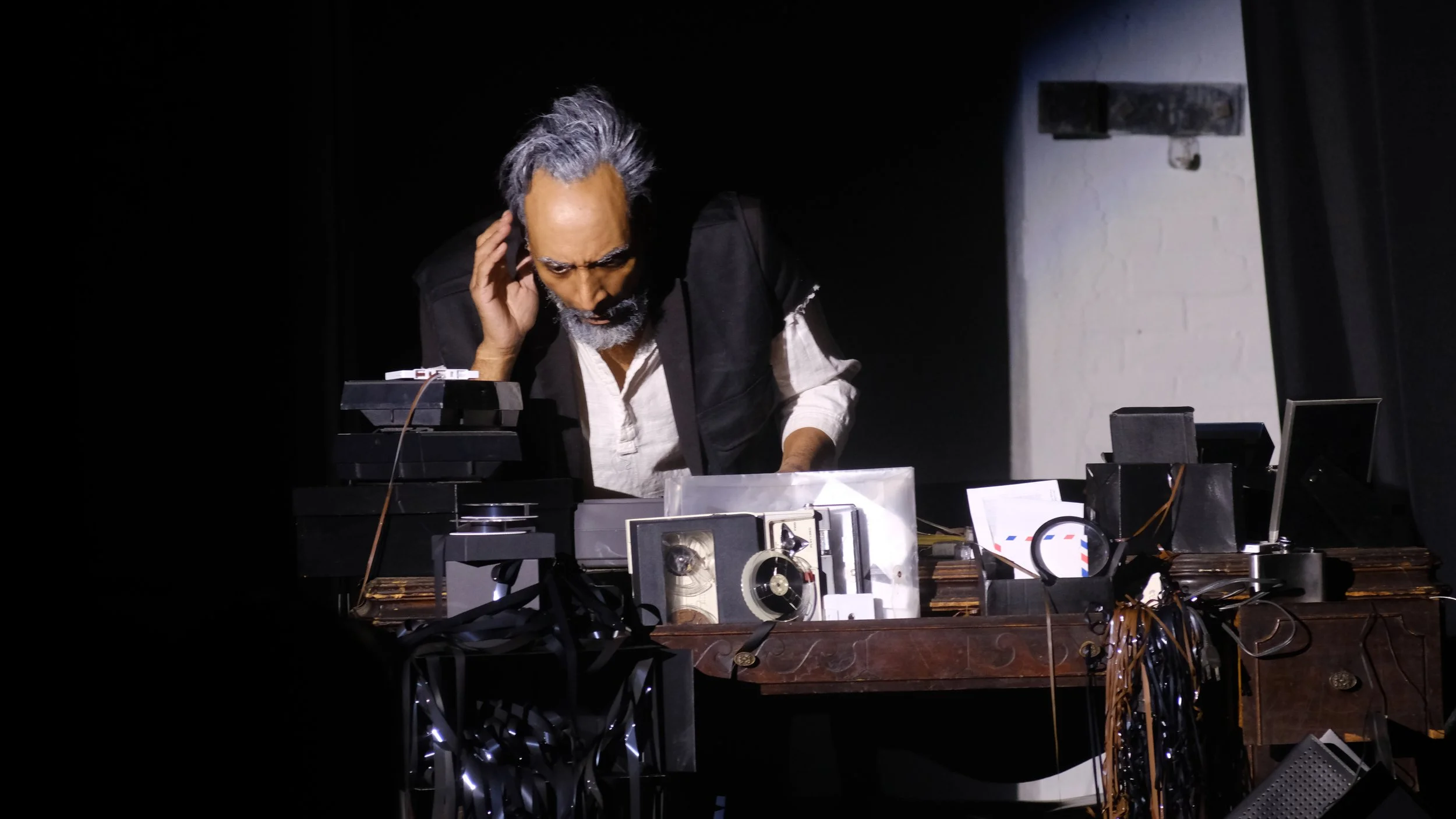
2022’s “Krapp’s Last Tape” saw Dennis Leroy Kangalee return to the stage in a whole new way and it inspired the formal creation of theater company that would merge different ideas about performing that had developed throughout the years.
The seismic shift from solo minimalism to group collaboration came about in 2023 when actor Che Ayende (As an Act of Protest, Macbeth on Broadway with Daniel Craig, etc) suggested reuniting and collaborating on an exploratory workshop of Hamlet. The idea was to pick up where they left of twenty years earlier in their first collaboration, the 2001 independent theatrical feature film
As an Act of Protest.
As an Act of Protest is a gritty, lo-fi revolutionary docudrama about the psychological effects of racism that leads to armed resistance. It has aesthetically and politically hovered over everything that Kangalee has created ever since. The film crystalized a lot of the beliefs that Kangalee Arts further developed for the next two decades. It brought the Black Arts Movement into the 21st cinema while simultaneously challenging nearly all the popular and underground modes of art at the time. It was a “Fanonian art film.” "Too political” for the art aesthetes and "too artsy” for the conformist Leftists. Although a film, it has been a central force in the revolutionary theater of the New Millennium as it acts as a conscience bearer for “protest artists,” “political artists” and those claiming to be revolutionary. The movie also crystallizes Kangalee’s notion of the Actor holding the most revolutionary promise of all artists, of all people. The film passionately presents and debates this idea. Blacklisted by the Giuliani administration and rediscovered years later, the film became a cult classic - finding an audiences amongst radical artists, Black guerrilla filmmakers, and poets in and around the avant-garde. But it eluded an entire generation, mystified its successors, was forgotten - and has now been rediscovered by an entirely new generation.
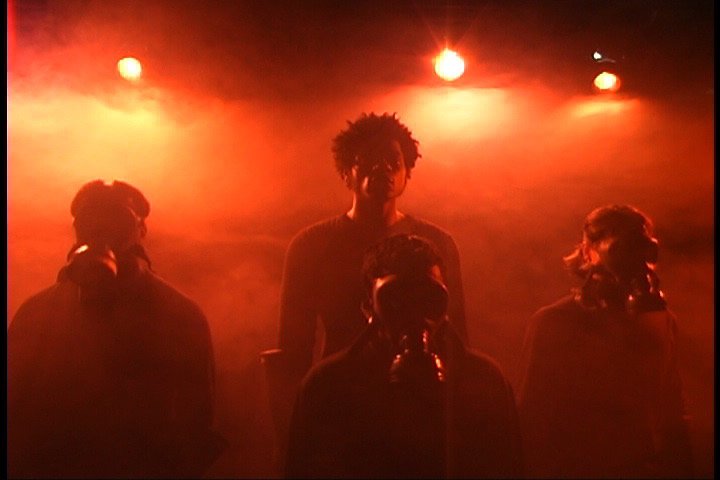
Rarely seen and out of circulation, the film had better reception, ironically, outside of NYC — particularly in the Southern part of the country like North Carolina and overseas in Europe. Distributed briefly by Speller Street Films, the film was streaming on Vimeo until 2025. READ MORE ABOUT IT HERE.
Lo-Fi Majesty: The startling climax in As an Act of Protest, was an imminent explosion of Fanon, Amiri Baraka and Hamlet…(2001, Kangalee, USA)
Hamlet
While Hamlet was a rehearsal exploration of Shakespeares’s tragedy, it was also a period of reclamation for many of the Black actors returning to classical theater and conscientiously forging new ways of making Shakespeare their own, going beyond the mere identification and rendering of the text: asking what it meant to do Shakespeare in the 21st century amidst catastrophes in our world and what the implications were for actors of color if identity and personal politics are inseparable from acting. This generated a new “Anti-Conservatory Approach” to Shakespeare. The workshop continued for nearly half a year and the deep exploration of tragedy gave way to the company’s first original work for the public, The Life & Death of Art.
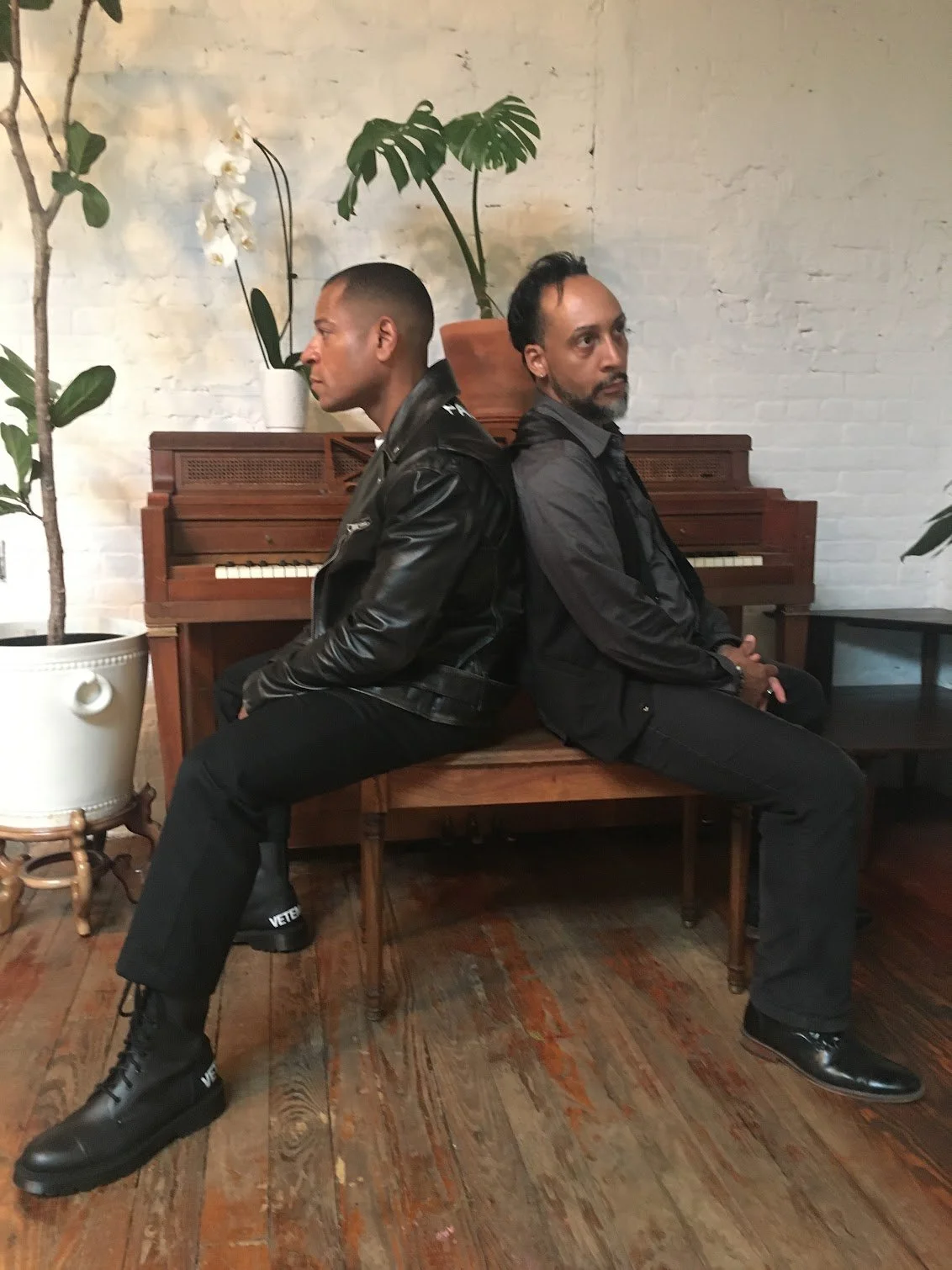
Understanding they had a responsibility now as mature artists who were concerned about the state of the arts, its lack of political engagement and receding nurturing as far as new American theater was concerned, they knew a repertory company had to be formed. They called upon the best actors they knew. An ensemble was formed!
Like musicians vamping, the play began as a series of organized improvisations and quickly grew into a formal script when DLK decided to write for specific members of the ensemble. Upon writing, he knew it would be the role of a lifetime for Ward Nixon, who was both muse and collaborator of DLK’s ideas since their first production in 1999, a revival of James Baldwin’s Blues for Mister Charlie at the National Black Theater. To this day it is still one of the most beloved independent theater productions Harlem' ever saw. DLK was committed to to enabling Ward Nixon play a new type of “hero” (anti-hero?) as the fictitious radical painter, Carver Carmelo. This grew into feverishly creating roles for other members of the company such as the brilliant Tessa Martin, best known for her own solo works in NYC and the fiery Justine Stock, co-founder of the west coast New Canon Theater. Stock and DLK had wanted to work together for over 20 years.
“Truthful and powerful, the most honest play happening in the theater right now!”
- Tony Vozzo, Playwright
The Kangalee Arts Ensemble's first original production was - “a dynamic expression of actor's freedom" and “the liberation of radical ideas that need to be given voice in a climate of apathy and genocide.”
The play is a combustible character driven ensemble piece that avails itself to the impact of both revolutionary politics and the new wave fascism that has run amok. A Brechtian excursion into the underbelly of the race and class war and the casualties of broken alliances under capitalism, The Life & Death of Art is one of the the very first American plays to engage with what is happening in both Gaza and the art world itself.
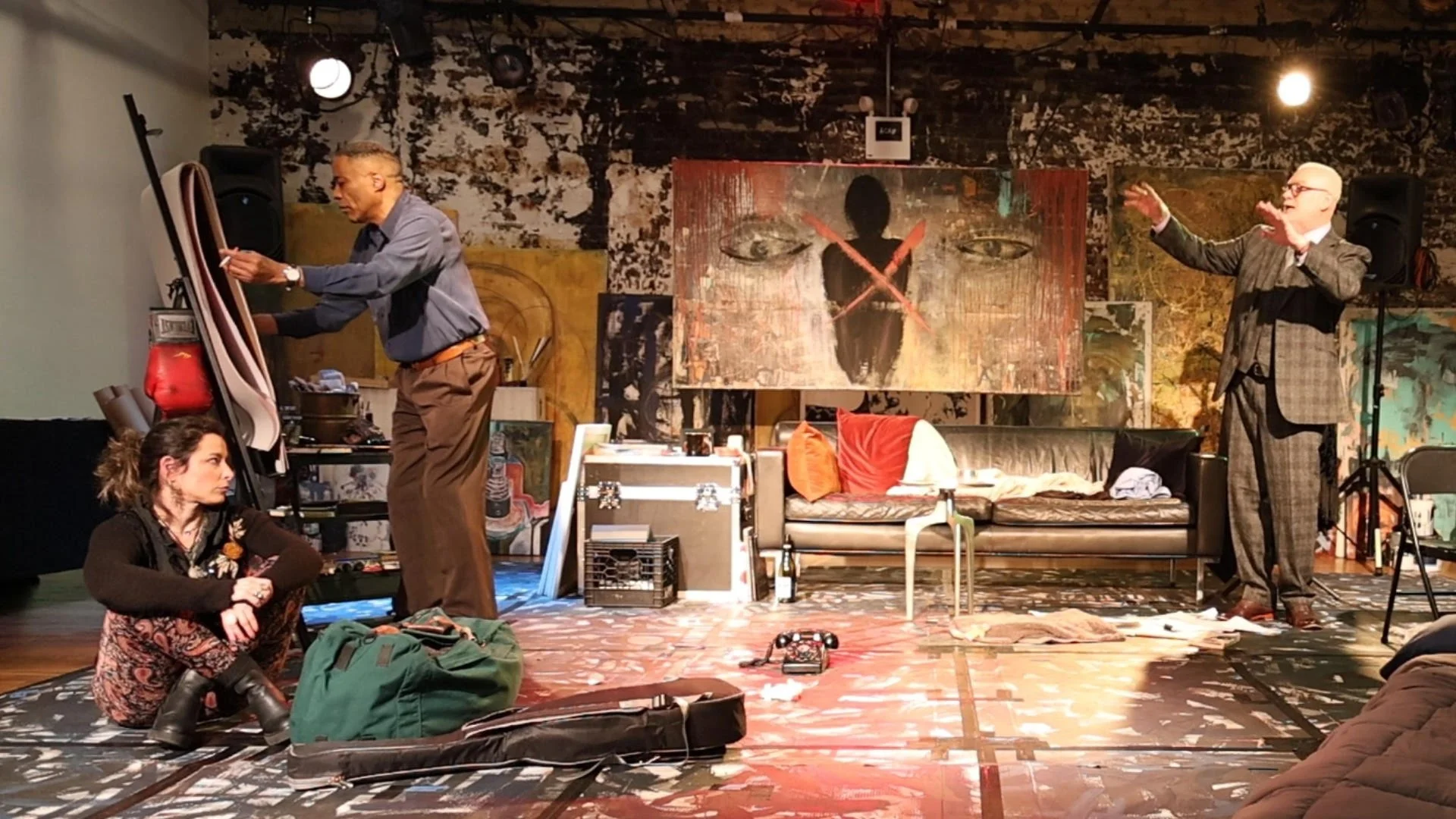
Elena (Justine Stock) Carver (Ward Nixon) and Solly (Ian Hersey) battling for Carver’s soul in “The Life & Death of Art.”
The first play in NYC to make a parallel and link of solidarity between Black Americans and Palestinians; parallel the venality of the fine arts world with US imperialism and the love of money with genocide, The Life & Death of Art was a powerful play that interrogated identity politics, making art during times of ethnic cleansing and overwhelming disintegration and what it means to be alive in this world with convictions that can’t be bought.